2026 Top Casting Automation Trends for Global Buyers

Time:2026-10-24 Author:Charlotte
0%

Global casting buyers are entering a practical automation decade. The question is no longer only “what is the role of automation in casting industry.” It is also about where automation creates measurable value.

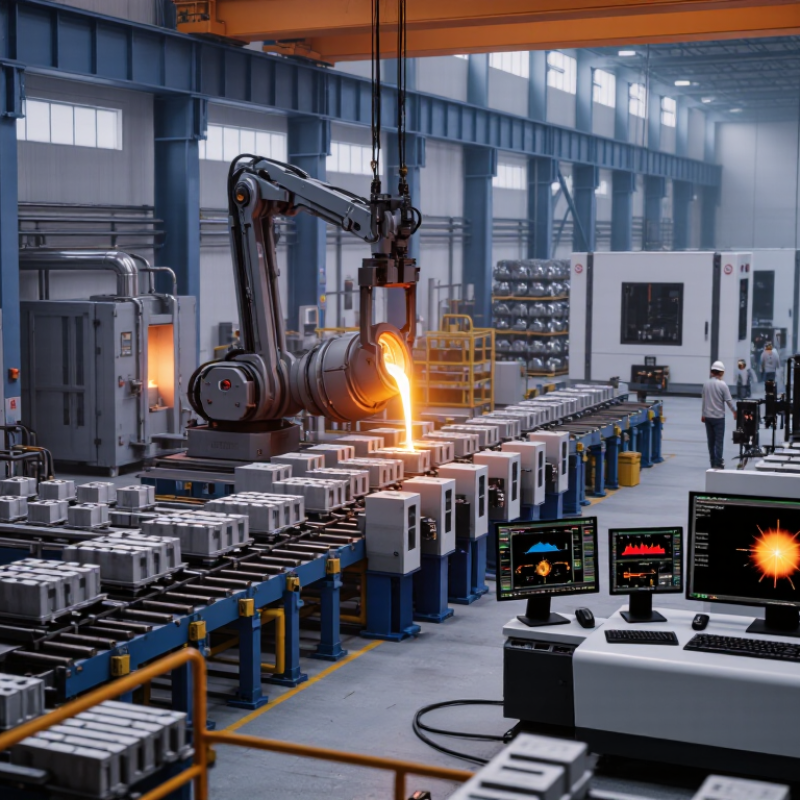
Modern foundries are connecting robotic pouring, automated molding, vision inspection, and real-time process monitoring. These systems can stabilize pouring temperature, reduce manual handling, and identify surface defects before shipment. A robotic arm can repeat a ladle movement within a narrow programmed path. Sensors can flag abnormal vibration before a machine stops. Small signals matter.

W. Edwards Deming, a respected quality-management expert, warned: “Automation applied to an inefficient operation will magnify the inefficiency.” His point remains highly relevant to casting. Automation cannot repair poor process design, weak maintenance, or unreliable data. It can expose them faster.

For global buyers, the 2026 trends require careful evaluation. Equipment should support traceability, energy efficiency, worker safety, and flexible production. It should also integrate with existing furnaces, molding lines, and enterprise systems. A technically impressive machine may still disappoint if operators cannot maintain it locally.

The strongest projects begin with process evidence. Buyers should compare cycle time, scrap rates, energy use, uptime, and training needs. Not every task needs a robot. Sometimes, a better sensor delivers greater value.

This market is advancing quickly. Yet, some forecasts sound too confident. Casting automation will not look identical across regions, metals, or factory sizes. Human judgment still matters, especially when production conditions change unexpectedly.
2026 Top Casting Automation Trends for Global Buyers

What Casting Automation Means in the 2026 Global Market

In the 2026 global market, casting automation means more than installing robots beside a molding line. It connects dosing, pouring, core handling, cooling, inspection, and production records. For global buyers, the real value is stable process control across shifts and sites. A sensor can detect metal temperature changes before a visible defect appears. A camera can identify surface marks within seconds. These tools turn scattered shop-floor signals into decisions that engineers can verify.

Experienced buyers are asking harder questions now. Can the system communicate with existing equipment? Can operators adjust recipes without complicated coding? Can maintenance teams find replacement parts locally? Energy monitoring also matters, especially when furnaces run through long production cycles. Automated cells may reduce handling risks and process variation, but they still require trained people. Poor calibration can repeat the same mistake faster. A real weakness. Software cannot repair unclear procedures or weak material control.

Reliable adoption depends on evidence, not impressive demonstrations. Buyers should request trial data, failure records, validation methods, and clear service responsibilities. Independent inspection can compare scrap rates, cycle times, and dimensional results before and after installation. Cybersecurity and data ownership deserve attention when equipment sends records across borders. Automation will not solve weak process design. In some plants, a simpler sensor network may deliver more value than a fully autonomous line. Not magic. The difficult question is often whether the factory is ready to use better data.

Core Technologies Driving Modern Casting Automation

Modern casting automation is moving beyond isolated robots. Core progress comes from connected sensing, adaptive control, simulation, and data platforms. The International Federation of Robotics reported 541,302 industrial robots installed worldwide in 2023. That figure signals a wider shift toward repeatable motion, safer handling, and measurable productivity. In foundries, robots now support ladling, pouring, trimming, grinding, inspection, and palletizing. Yet automation is not simply a robot purchase. Poor thermal data can still produce poor castings.

Thermal cameras and in-mold sensors help engineers monitor filling, solidification, and die conditions in near real time. Machine-learning models can flag process drift before scrap becomes visible. Digital twins add another layer by testing cycle times, cooling paths, and maintenance scenarios before physical trials. The World Economic Forum’s Future of Jobs Report 2023 lists analytical thinking and technology literacy among the most important workplace skills. Operators must interpret data, not merely press start. Simulation also deserves caution. A model may look precise while missing alloy variation, sand moisture, or human intervention. This is where many projects become less perfect.

Tips: Begin with one measurable bottleneck, such as trimming time or inspection escapes. Install reliable sensors before adding advanced AI. Track uptime, scrap, energy use, and changeover time together. Review results with operators every week. Their practical objections often reveal the real failure point.

Key Automation Trends Reshaping Foundries in 2026

Key Automation Trends Reshaping Foundries in 2026

Casting automation is moving from isolated machines toward connected production cells. Buyers increasingly expect robots, sensors, and control systems to exchange data in real time. The International Federation of Robotics reported 541,302 industrial robot installations worldwide in 2023, a 10% increase from the previous year. This growth signals stronger demand for automated handling, pouring, trimming, inspection, and palletizing.

The shift is practical. Machine vision can detect surface defects before shipment, while thermal sensors monitor mold and furnace conditions continuously. Predictive maintenance systems also use vibration and temperature data to identify failures earlier. Deloitte’s 2024 Smart Manufacturing and Operations Survey found that 86% of manufacturing leaders viewed smart manufacturing as important for competitiveness within five years. For foundries, this means automation must improve uptime, traceability, and worker safety, not simply reduce labor.

Energy intelligence will become more influential in purchasing decisions. Connected meters can compare electricity use across melting cycles, compressed-air systems, and cooling equipment. Digital twins may help buyers test process changes before modifying physical lines. Yet these systems are not effortless. Poor sensor calibration, inconsistent data, and limited operator training can weaken results. Buyers should question integration costs, maintenance access, cybersecurity controls, and the availability of technical support. A fast installation is not always a reliable one.

How Global Buyers Can Evaluate Casting Automation Systems

Global buyers should evaluate casting automation as a complete production system, not a collection of impressive machines. Start with the part family, alloy, mold size, and annual volume. A system suited to small aluminum components may struggle with heavier castings. Ask suppliers for cycle-time data from comparable parts, not laboratory demonstrations.

Check how the equipment handles ladling, mold changes, trimming, inspection, and material transfer. These interfaces often create hidden delays. Request records showing uptime, reject rates, maintenance hours, and energy use. Numbers matter more than polished presentations. Also review software compatibility, remote support, spare-part availability, and operator training in your region. A low purchase price can become expensive when local service is weak.

Safety and compliance require documented evidence. Examine guarding, emergency controls, electrical standards, noise levels, and worker access points. Confirm whether the system supports traceability for each batch and process adjustment. Run a factory acceptance test using your own production conditions. It may expose weaknesses.

Do not assume full automation is always the best answer. A semi-automated cell may offer better flexibility for mixed orders or frequent tooling changes. I have seen evaluation teams overvalue speed and undervalue changeover time. That mistake is easy to repeat. Use a weighted scorecard, involve operators early, and leave room for imperfect data.

2026 Top Casting Automation Trends for Global Buyers

How Global Buyers Can Evaluate Casting Automation Systems

This evaluation framework prioritizes the factors that most directly influence casting automation performance, lifecycle cost, production stability, and global deployment readiness. Buyers should validate each target with machine trials, reference parts, safety documentation, and total-cost-of-ownership calculations.

Implementation Factors, Risks, and Future Readiness

For global casting buyers, automation is moving beyond robotic pouring. Connected cells now combine ladle handling, mold transfer, vision inspection, and production data. The International Federation of Robotics reported 541,302 industrial robots installed worldwide in 2023. This signals strong automation capacity, but casting environments remain difficult. Heat, dust, vibration, and variable part geometry can quickly expose weak planning.

Implementation starts with process evidence. Buyers should measure cycle time, scrap causes, furnace stability, and operator exposure before selecting equipment. A 2024 manufacturing outlook from Deloitte found that workforce capability remains a major barrier to advanced production adoption. Training must include fault recovery, sensor calibration, and safe manual intervention. Small trials matter. A pilot cell with real alloys and actual molds reveals problems that simulations often hide. I have seen impressive demonstrations fail when access for cleaning was ignored.

Risk control needs practical detail. Critical sensors should have protected cabling, spare units, and clear maintenance intervals. Data systems also require ownership rules, since inconsistent tags can corrupt quality analysis. The World Economic Forum’s Future of Jobs Report 2025 identifies technological change and reskilling as major forces through 2030. Future-ready systems should therefore use open interfaces, modular grippers, and adjustable recipes. Yet full automation is not always wiser. Some low-volume castings still need skilled judgment, especially when defects appear irregularly. That uncomfortable exception deserves budget, not denial.

FAQS

What technologies support modern casting automation?

Connected sensors, adaptive controls, simulation, machine learning, and data platforms support modern casting cells. Robots handle pouring, trimming, grinding, inspection, and palletizing. Machines help, but data quality still matters.

How can thermal sensors improve casting quality?

Thermal cameras and in-mold sensors monitor filling, solidification, and die conditions. They can reveal unusual heat patterns before defects become obvious. Poor calibration may still mislead operators.

Should buyers choose full automation for every casting process?

No. Full automation may suit stable, high-volume parts with predictable tooling. Semi-automated cells can work better for mixed orders and frequent changes. Flexibility matters.

What information should buyers request from equipment suppliers?

Request cycle times, uptime, reject rates, maintenance hours, and energy use. Ask for data from comparable parts, not polished demonstrations. Laboratory results can look better than factory results.

Which production details should be measured before implementation?

Measure cycle time, scrap causes, furnace stability, changeover time, and operator exposure. Record actual alloys and mold conditions. Baseline data makes later improvements easier to judge.

Why are operator skills important in automated foundries?

Operators must interpret data, recover faults, calibrate sensors, and intervene safely. Their practical objections may expose cleaning, access, or maintenance problems. Listen closely.

What safety and compliance details need review?

Review guarding, emergency controls, electrical requirements, noise levels, and worker access points. Confirm documented maintenance and safe manual procedures. Safety cannot be left to assumptions.

How can a pilot test reduce automation risks?

Run a pilot cell with real alloys, molds, and production conditions. Test cleaning access, changeovers, sensor reliability, and fault recovery. Simulations may miss ugly details.

What makes a casting automation system future-ready?

Choose open interfaces, modular grippers, adjustable recipes, and clear data ownership. Protect sensor cables and keep spare units available. Future plans often change.

How should buyers compare automation projects fairly?

Use a weighted scorecard covering quality, uptime, flexibility, safety, service, training, and operating cost. Involve operators early. Speed alone can create expensive regret.

Conclusion

Casting automation in the 2026 global market is evolving from isolated machine control into an integrated production strategy. It combines robotics, sensors, data systems, simulation, and intelligent process monitoring to improve productivity, consistency, safety, and resource efficiency. The key technologies include automated material handling, robotic pouring and finishing, real-time quality inspection, connected equipment, and data-driven process optimization. A central question for industry decision-makers is: what is the role of automation in casting industry? Its role is to reduce variation, support skilled workers, lower operational risks, and create more predictable production outcomes.

For global buyers, evaluating a casting automation system requires more than comparing equipment specifications. Buyers should consider compatibility with existing facilities, production flexibility, maintenance support, workforce training, cybersecurity, energy use, and the supplier’s ability to provide scalable solutions. Implementation should begin with clear performance targets, phased testing, and risk assessment. Systems designed for interoperability, reliable data use, and future upgrades can help foundries remain competitive while adapting to changing market demands.

Charlotte

Charlotte

Charlotte is a seasoned marketing professional with a deep understanding of the company's portfolio and a passion for elevating its presence in the market. With a keen eye for detail and a commitment to excellence, she ensures that our professional blog is regularly updated with insightful articles......